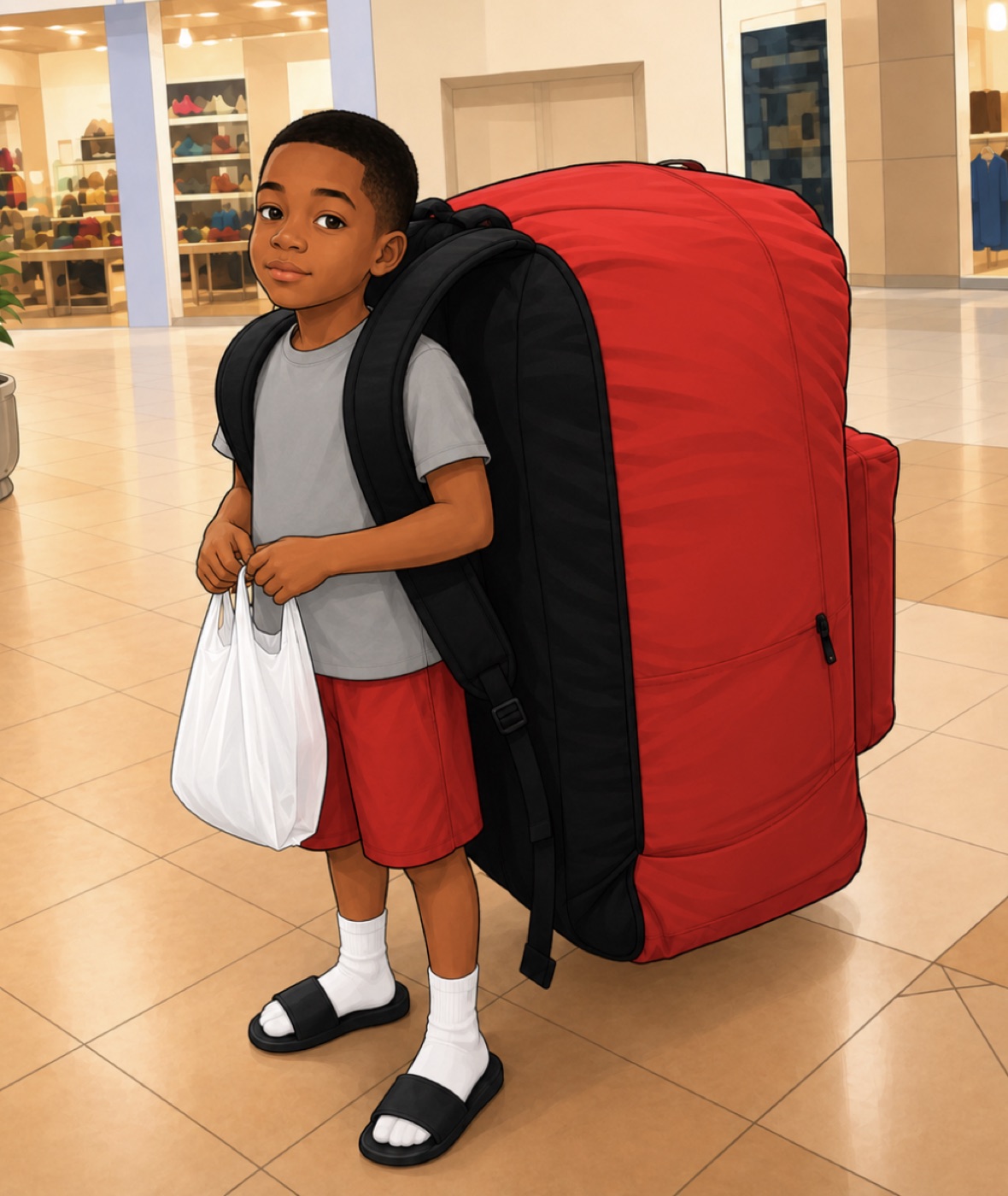
Sometime in the next few weeks, summer will abruptly end. You will stand at a bus stop, or drop off at school, watching a child walk away from you with that super large backpack. You will feel an ache in the moment, pride and grief holding hands, and underneath it a question will stir as this new year begins. Do we have the skill to be successful parents here? Is our kid ready?
I muttered it 25 years ago, and pretty much every year since, but I think I was asking the wrong question. No first-time parent has a clue how to parent their own child. It cannot be otherwise. This small person has never experienced the world before, and the world has never held this small person, which means this child has never been parented before, anywhere, in all of human history. There is no expert on them. There is no book about them. The knowledge you are afraid you lack does not exist yet, because it has to be made, and it can only be made by the two of you, a moment and a day at a time. This stays true for the second child and the next, since each one arrives unprecedented.
I watched the proof of it years ago at a co-op preschool. A few parents there had a firstborn who made their method look unimpeachable, calm and early to everything, slept through the night, walked and talked early, and the rest of us quietly wondered what we were doing wrong. Then their second child arrived, a different weather system entirely, and the method met a person it had never met. Within a season they were back among the rest of us, which of course is where they had been all along. No parenting skill is universally superior, because no child is a general case. So the starting line is level in a way our anxious culture never admits: every parent of every child begins as a beginner, and the professionals begin there too.
I learned something unexpected over my years of preparing foster parents, about who was truly ready to venture into that difficult space. Part of my life-work was recruiting, licensing, and training foster parents. The families came from every background you can imagine. Some held advanced degrees in counseling and therapy; they could name every attachment style and diagram a trauma response or teach CBT or DBT (Cognitive or Dialectical Behavioral Therapy). Others were immigrant grandmothers and uncles and young couples with no letters after their names, taking in children who had survived trafficking and harm I will not describe here, harm that would justify any amount of specialized training the world could offer.
Here is what I watched happen, again and again, until I could no longer pretend it was a coincidence. Some of the most educated and credentialed among them struggled hard when the theory met 24/7 parenting. The whiteboard does not get up at three in the morning. The diagram does not hold steady when a child tests the same boundary for the umpteenth time before breakfast. And some of the parents the system quietly labeled unskilled, the ones who had raised children through war and displacement and poverty, rolled with punches that would have flattened a clinical team. They cooked. They stayed. They laughed at some moments and wept at others and got up the next day and did it again. Not one of them was without trials. Not one of the trained parents failed simply because of their training, either; some were wonderful, and their knowledge served them. But the thing that separated the homes where children healed from the homes where they did not was never the credential. It was a posture that persevered, a love that did not depend on the child performing wellness on a schedule.
I have carried that lesson for decades now, and modern science has caught up with those abuelas. Daniel Siegel, a psychiatrist who has spent his career studying how relationships shape the developing brain, writes with the psychotherapist Tina Payne Bryson that a child needs four things from the people who raise them: to feel safe, seen, soothed, and secure. Read that list slowly. There is no course requirement or vocabulary test. Safe means your presence is a refuge and never a threat. Seen means you notice who this particular child actually is, not the child the checklist expected. Soothed means that when the storm comes, and it will come, you stay in the room and lend them your calm until theirs returns. Secure is what grows in a child from years of the first three, the settled knowledge, deeper than memory, that someone is for them. Every one of those is a matter of showing up. None of them is a matter of certification.
This does not mean we can do it well every day. I could not. You will lose your temper in the car. You will say the sharp thing and watch it land. You will miss the signal because you were tired, and you will be tired often. So there is a second piece of good news: the repair matters more than the rupture. A parent who can come back afterward and say plainly, I got that wrong, I was frustrated and it came out at you, and I love you, teaches a child more about being human than a hundred smooth afternoons ever could. Your mistakes are not the failure of the adventure. They are part of its terrain, and walked humbly, they become the places where trust grows thickest.
If I could hand every parent one tool for the year ahead, it would be a habit of mind that a writer named Julia Galef describes as the scout mindset. A soldier defends a position; a scout goes out to see what is actually there. Much of the anxiety of modern parenting comes from being conscripted as soldiers, defending a method, a philosophy, a side in whatever the argument of the moment happens to be, sleep training or screen time or the right kind of kindergarten. The scout puts the argument down and studies the actual child in the room. What lights this kid up? What frightens them, and when? What did we try last month, and what did it teach us? Scouts get to be curious instead of defensive. Scouts get to update without shame. And a scout is very hard to panic, because the headline of the week is never a match for the evidence of your own household.
The scout also learns to move at the speed the territory requires, and here another writer earns his place at the family table. Cal Newport has spent years arguing that the best work happens when we do fewer things, at a natural pace, with real care for quality. He is writing about careers, but a parent can read that sentence twice, because childhood is exactly such a territory. The culture will offer you a family calendar shaped like a corporate sprint, more activities, more enrichment, more optimization of the very children we claim to treasure. You are allowed to decline! A slow dinner where somebody tells a bad joke is development. A Saturday with nothing on it is development. The unhurried hour in which a child putters beside you while you fix something or cook something is not the empty space between the important parts of childhood. It is the important part.
School is starting, and with it a season of systems: schedules, forms, screenings, and assessments, all of it useful and none of it in charge of your child. The teachers will do good, real work, and they deserve your partnership. But the classroom is not taking over your child’s formation, and no stage of development, not kindergarten, not the wilds of fourth grade, not the far country of adolescence, transfers the child’s roots to an institution. Each stage is something else entirely: an invitation for the two of you to grow together. Your child will learn to read, and you will learn a new patience. Your child will meet friendship and its bruises, and you will learn when to step in and when to sit on your hands (which is the harder lesson). Anyone who has raised a child to adulthood will tell you the honest secret, that the parent graduates too, changed, stretched, and more thoroughly educated by the child than by anything else in their life.
Some of you are parenting through more than the ordinary weather, and let’s not speak past you. There are children whose needs are genuinely specialized, and there are seasons when wise families call in help, a teacher, a doctor, a counselor, an elder, and calling for help is an act of strength and not a resignation. But I have watched a lot of families over thirty years, and much of what gets labeled a special circumstance is a normal growing pain arriving with extra intensity. The tantrum is bigger, the fear is louder, the stage lasts longer than the book said it would. Intensity is not a verdict on your child, and it is certainly not a verdict on you. Some of it is a child made differently, and a difference is not a defect either. And even where real help is needed, the helpers work for the family and not the other way around. You have become the closest thing to an expert this child has. Whatever data there is on this child, most of it lives with you.
So let the backpack walk away from you this fall, and let the ache come. You are not sending your child off to be raised by professionals while you wait in the parking lot of their childhood. You are on an adventure together, the two of you, all of you, and it will be filled with mistakes and joy and sorrow in proportions no one can predict. The grandmothers and papas I trained those years ago would tell you what they told me, in a dozen languages and with no letters after their names: stay close, keep loving, get up the next day. The rest can be learned along the road. It always has been.