Share your Reflections, your Story, in Your Voice
Write in your language. Share your voice with the community — in whatever language you think and feel in.
The Watershed and the Pipe
On the difference between community health and the industrialization of distress. What happens when we build pipes faster than we can see what they do to the watershed.
Every government function that displaces a civil society function makes the civil society function harder to rebuild. Once the fifth branch of public safety exists, police, fire, EMS, 911, and now mental health crisis response, the neighbor who would have sat with someone has a number to call instead. The call is easier than sitting. The sitting stops happening. The capacity atrophies. The system has produced its own permanence.
The Formation Wage
What If We Paid Parents Instead of Paying to Replace Them?
I’ve been building furniture for a quarter century. When you work with wood long enough, you stop trying to make the material do what you want. You learn to read it—where the grain runs, where it wants to split, where it will hold a joint and where it won’t. A furnituremaker who fights the grain can produce something that looks fine on the surface. But it won’t hold. It cracks along the lines you refused to read. I’ve also spent thirty years working with families—youth homelessness, foster care, refugee resettlement, multicultural family development across the Puget Sound. And what I keep seeing is systems that build against the grain of the people they serve. Not because anyone wants to. Because the system can’t imagine anything else. Here’s what I mean. A 22-year-old parent shows up at a family shelter with a toddler. Her own brain is still developing—the neuroscience on prefrontal maturation is clear about this, it continues into the late twenties. Her child’s brain is building its entire regulatory architecture from the quality of her presence. Both of these developmental windows are open at the same time. So here are these two open windows. And what does the system do? A resume workshop. Job placement. Childcare subsidy so the parent can work forty hours a week and the toddler can be in institutional care during the exact years when that child’s brain most needs the parent’s consistent, unhurried presence. Le Guin wrote that without the skills of imagination, our lives get made up for us by other people. I think the same thing happens to systems. We couldn’t imagine that the parent’s presence with that child might be the most valuable thing happening in the entire shelter. So we made up a different story for them—the employment story, the self-sufficiency story—and the grain kept cracking.
The Village Square
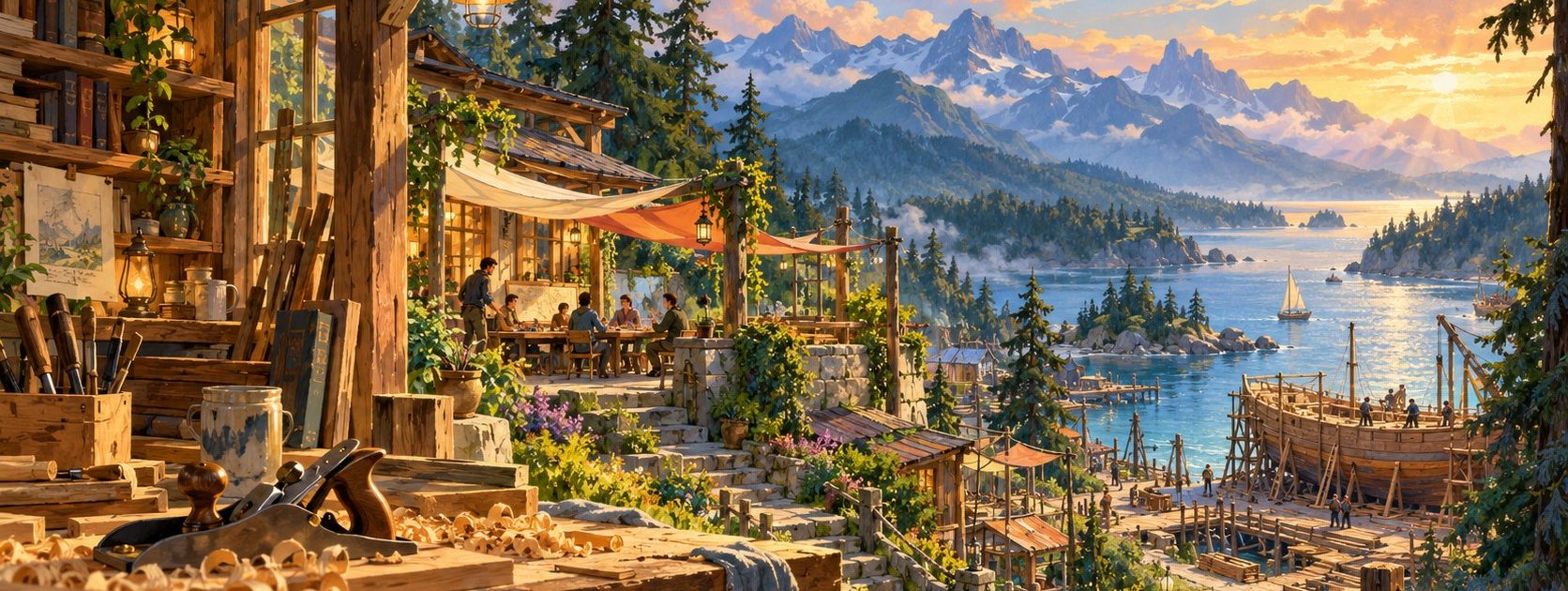
The square has four faces. A table sits at the center.
The Threshold (goodprotocols.org) — You’re standing here. The place of arrival, where every language has a seat and every person is received. The frameworks, the writing, the community’s own voices — shared in the languages they speak. The first sound you hear.
The Boatyard (goodprotocols.ai) — Vessels for communities and organizations. Compound curves, unsquare lines. Co-regulation as organizational architecture. A crew bending ribs together. The community that sounds.
The Studio (goodprotocols.ai) — Ongoing practice. The instrument gets better with use. You don’t come back because you’re broken. You come back because the frequency gets truer. The frequency refined.
The Slow Table — at the center of the square. A shared meal. Unhurried conversation. The gathering that connects all four buildings. Someone has set a cloth on the table.
Start with the story behind Good Protocols. Explore The Square for shared frameworks and the formation canon. Or just reach out.