 An essay for Easter and the season of return
Paul Tan
Good Protocols · April 2026
“The act of making is an act of hope—a small resurrection.”
— Makoto Fujimura
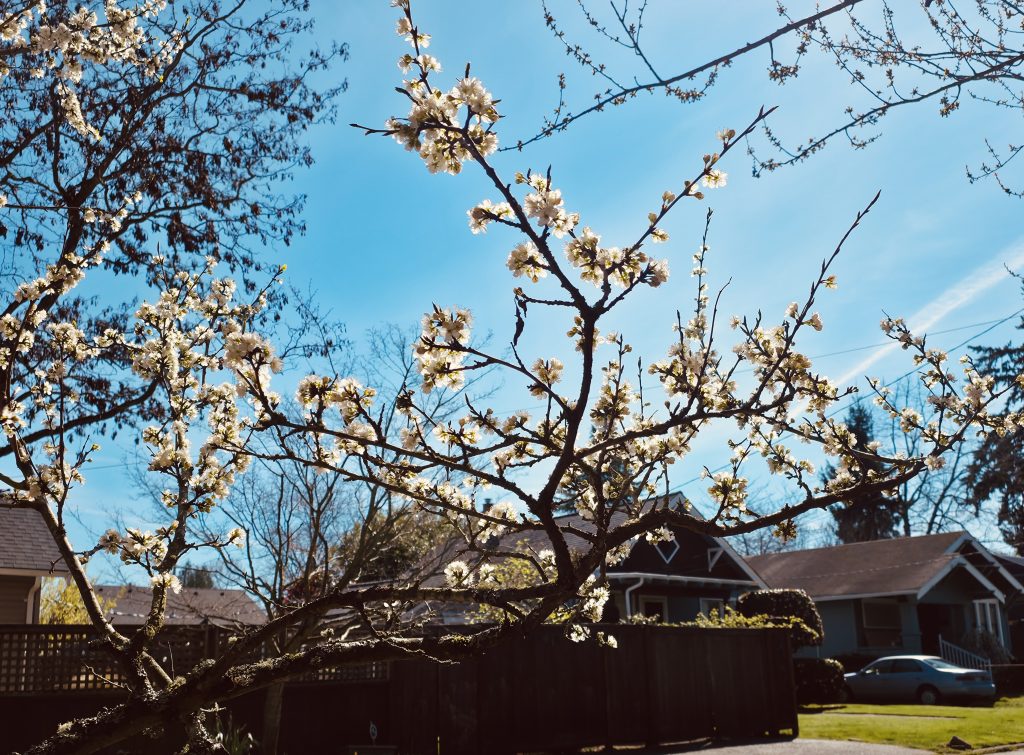
The plum tree along the street blooms before anything else. It blooms so early it seems reckless—purple-white blossoms opening into air that is still cold, still carrying the last of February’s gray. Every year I think it’s too soon. Every year the blossoms come anyway.
They did not arrive. They returned. They were in the wood all winter—held in the dark, in the cold, in the branch that looked bare through the kitchen window for four months. I walked past that tree every day in January. I saw a bare branch. I saw nothing happening. But the branch was not empty. The branch was holding.
I have been thinking about what holds things in the dark. What is doing its work when no one can see it working. What blooms not because someone made it bloom but because the holding was patient enough and the season finally turned.
There is a child I know whose feelings are enormous. He is seven. When the frustration comes—or the sadness, or the excitement that is so big it arrives as his whole body in motion—it fills the room. His teacher and principal hold him through it. Not fixing it. Holding it. They have been holding it since he began kindergarten. They do not see what is being built because they are inside the building.
What is being built: the roads. The actual, physical neural pathways that will carry his thoughts and his feelings for the rest of his life. The roads are under construction. The big feelings are driving on roads that aren’t finished yet—which is why they crash. That’s the meltdown. Not a failure of the child. Not a failure of the parents. An unfinished road meeting a feeling that is already full-sized. The parents’ and teacher’s patience—the holding, the calm voice, the body that stays near when the child’s body is in chaos—is the construction crew. They are building the road. They can’t see it. But every time they hold the feeling without shaming it, the road gets a little longer, a little smoother, a little more capable of carrying what this child will need to carry.
The blossoms are in the wood.
A painter I admire—a Japanese American artist who works with mineral pigments and gold leaf—once said that the act of making is an act of hope. A small resurrection. I have been collecting small resurrections this spring the way a person collects stones on a walk—not because they are valuable but because each one fits in the hand and carries something.
Here is one. A twelve-year-old who has spent the better part of a year behind a closed bedroom door—earbuds in, homework undone, communicating in monosyllables—comes into the kitchen on a Saturday morning and says, “Can you teach me how to make Grandma’s soup?” The parent stands at the counter and does not cry, though the crying is close. The recipe is handwritten on a card that is stained and soft from years of handling. The grandmother is gone. The soup is the inheritance. And the young person—who the parent thought was lost to the screen, lost to the monosyllables, lost to whatever was happening behind that closed door—is standing at the counter asking to receive it.
The parent did not make this happen. The parent set the table a thousand times. The parent cooked the soup every winter. The parent kept the recipe card in the drawer where the child could find it. And then the season turned. The daughter’s hands are in the flour now. The grandmother’s recipe is passing through the parent’s hands into the girl’s hands, and the passing is the resurrection—small, quiet, in the kitchen, on a Saturday, unwitnessed by anyone except the two of them and the flour dust in the morning light.
Here is another. A father who works with his hands—construction, long hours, the kind of tired that lives in the shoulders—comes home and sits in the yard. He does not announce himself. He sits. And his teenage son, who has been angry for months—angry at the school, angry at the friends, angry at the father for reasons neither of them can name—comes outside and sits next to him. They do not speak. The sky does whatever the sky does in early April in the Northwest: gray, then gold, then gray again. They sit for ten minutes. Then the son goes inside.
The father thinks nothing happened. Everything happened. The boy chose to be near. The choosing was the blossom. It opened in silence, in a yard, in the last light of a Tuesday. Nobody photographed it. Nobody posted it. Nobody at the school will ever know that the behavioral problems they documented in the boy’s file are blooming into something the file cannot hold: a son who is learning to sit with his father, in silence, and let the silence be enough.
Here is a third. A child brings home a clay pot from school. It is lumpy. It is glazed in a green that the child chose and the parent would not have. It is—and this is the word that matters—made. A person who is seven years old put their hands in clay and shaped something that did not exist before. The thing is not beautiful by any measure the world uses. The parent puts it on the table. Not on a shelf. On the table—where the food goes, where the family eats, where the evening happens. The pot is at the center of the family’s life. Not because it is good. Because it was made. And the making, the painter would say, is the resurrection.
Tomorrow is Easter, or it is near Easter, or Easter has just passed—the essay does not know the exact day you are reading it, and the exact day does not matter. What matters is the table.
Not the performance table. Not the one where the napkins are folded and the lamb is roasted and the family arrives in the clothes they bought for the occasion. That table has its place. But the table I am thinking of is the one underneath that one—the table that exists every night, not just on holidays. The table where the food was made by hands that are tired. Where the conversation wanders. Where the child is too old for the egg hunt but goes anyway because the little cousin still believes and someone has to hide the eggs low enough. Where the grandmother tells the story she tells every year and this year, for the first time, the teenager listens—not because the story changed but because the teenager did. Something in the teenager’s ear opened. The story landed.
That table is not perfect. It holds the argument from last week that hasn’t been resolved. It holds the uncle who drinks too much and the aunt who compensates by being too cheerful. It holds the empty chair—the person who should be here and isn’t, for whatever reason they aren’t, and the family holds the absence by not filling the space with noise. The table holds all of it. Not that perfect symmetry, a cabinetmaker once said about the ships he saw as a boy. But always something alive.
I have spent thirty years working with families, and the truest thing I know is this: the table is the thing. Not the curriculum. Not the program. Not the parenting strategy or the screen time rule or the enrichment activity. The table where people eat together, slowly, without an agenda, without anywhere to be afterward—that table is doing the deepest work. The child’s nervous system is being regulated by the parent’s calm presence. The parent’s loneliness is being held by the company. The grandmother’s story is being planted in the teenager’s memory like a seed that will not bloom for ten years. The family’s music is sounding—not a performance, not a rehearsed piece, but an improvisation, a jazz session where each voice enters and listens and responds and the music that emerges belongs to no one and to everyone and will never be played exactly this way again.
Set the table. That is the whole thing. Set the table and sit down and let the evening find its own length. The formation of your family—the slow, invisible, patient work of building people who know who they are and whose they are—is happening right now, at the table, in the passing of bread and the asking of questions and the silence that holds the questions that have no answers yet.
I know what you are thinking because I have sat across from a thousand parents who thought the same thing. You are thinking: I don’t see the blossoms. I see the bare branch. I see the homework battle and the screen and the eye-roll and the nine o’clock exhaustion when the children are finally asleep and the house is quiet and you sit with a weariness that goes deeper than tired. You sit with the question the culture will not let you ask out loud: is any of this working?
It is working.
You cannot see it because you are the branch. The branch cannot see its own blossoms—it can only feel the weight of them. And the weight feels like everything you have been carrying: the school conferences and the co-parenting and the financial stress and the question of whether you are doing enough and the guilt when you lose your patience and the loneliness of doing this without the help you need. That heaviness you feel is not failure. It is fruit. The fruit is setting. You are the branch it grows on. You will not see it from inside. You are inside it.
But someday—not today, not this Easter, but someday—your child will walk through a door and hold the room for someone who needs holding. They will set a table. They will sit with someone in silence and the silence will be enough. They will tell the grandmother’s story to their own children and the story will land the way it landed in them—not because they remember the words but because they remember the table. They will make something with their hands and put it at the center of their life, not because it is good but because it was made. And they will not know where they learned any of this. But you will know. You will know it was the table and the holding and the patience and the mornings you got up and set the table again even though no one thanked you. You will know it was the winter. You will know the blossoms were in the wood all along.
The plum tree does not ask whether its blossoms are good enough. It does not compare itself to the cherry tree down the street whose blossoms are more photogenic. It does not scroll through images of other trees’ blossoms and wonder if it is blooming wrong. It blooms because the season turned and the wood could not hold the blossoms any longer. The blooming is not a decision. It is what happens when the holding has been long enough and the light has been warm enough and the branch has been faithful enough to the slow, invisible, patient work of being a branch.
Your family is a tree. Your patience is the branch. Your table is the ground. And the spring—this spring, the one outside your window right now—is the season that says: what you have been holding in the dark is ready to open.
You may not see it yet. That is all right. The blossoms do not need you to see them. They need you to keep holding the branch. The season will do the rest.
Set the table. Sit down. Let the evening find its own length. The small resurrections are already happening. They are in the wood. They are in your hands. They are in the bread you are passing and the story you are telling and the silence you are holding and the lumpy green pot at the center of the table that your child made with their own two hands. Happy Easter. Happy spring. The blossoms are returning. Always coming home.
Paul Tan is the founder of Good Protocols, a social purpose corporation in south Seattle building formation communities for families navigating the school years. He is the author of True Frequency: Finding the Sound Every Person Carries (forthcoming). He has spent thirty years in the Puget Sound region working with families, young adults, and communities. He is also a finish carpenter.
goodprotocols.org · paul@goodprotocols.org